
TL;DR / Key Takeaways:
- Most breakage during a move is caused by under-packing — items shifting inside the box — not rough handling.
- Pack dishes vertically like records, not stacked flat. This single change prevents the majority of dish breakage.
- Every fragile item needs individual wrapping. Wrapping items in groups is not wrapping — it’s just bundling.
- A properly packed box makes no sound when you shake it gently. If anything moves inside, add more packing paper.
- Never use printed newspaper on anything light-colored — the ink transfers and can stain permanently.
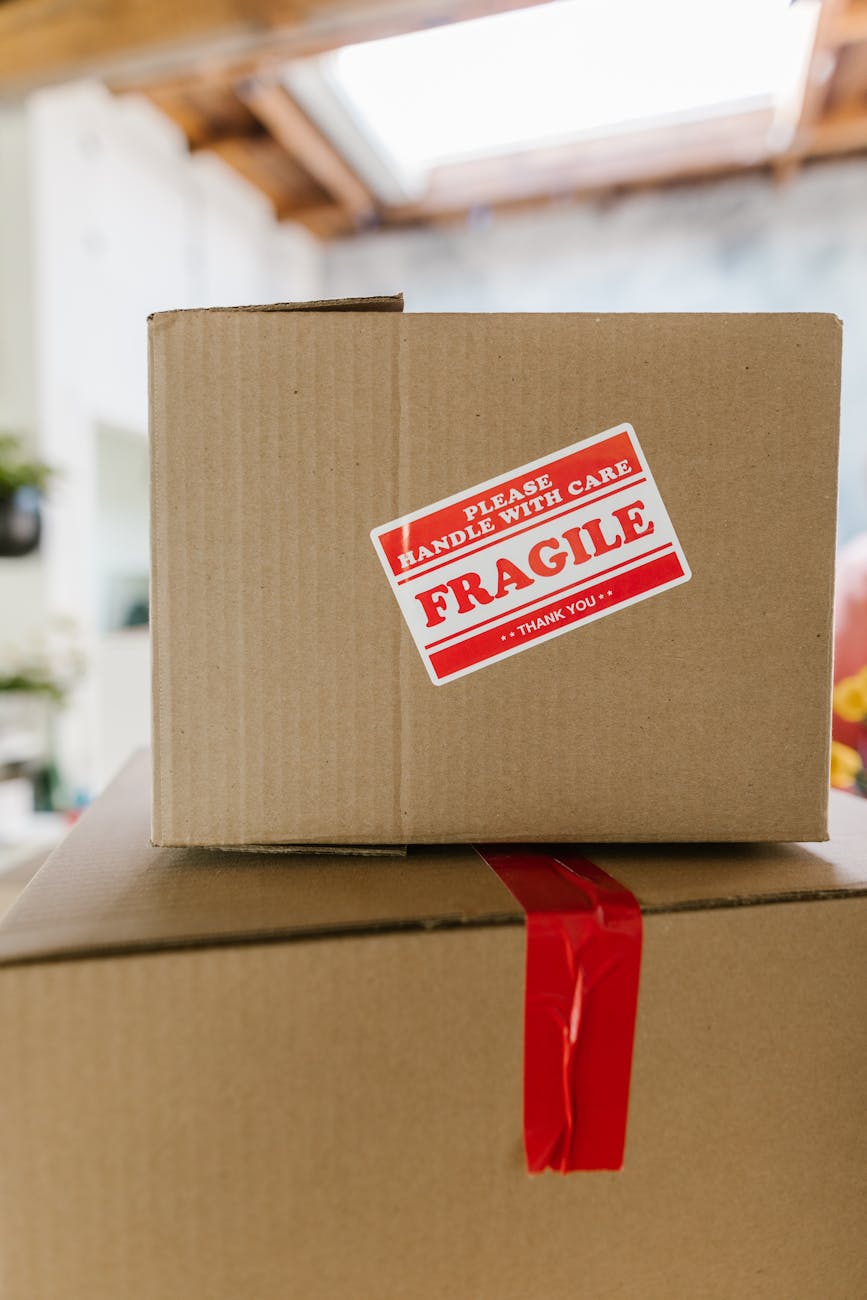
- Mark FRAGILE in red marker on every side of the box, not just the top — movers stack boxes and the top label disappears.
The most common assumption people make about broken items during a move is that something got dropped or handled carelessly. That does happen — but it accounts for far less breakage than the actual leading cause: items that weren’t packed tightly enough and shifted inside the box during transport. A box that looks full but has items loose inside it is a box where things break. The technique is what matters, not the luck.
This guide covers how to pack fragile items of all categories correctly — dishes, glassware, stemware, artwork, mirrors, electronics, lamps, and more — with the specific materials and techniques that prevent breakage. It also covers what movers look for in a packed box and why certain common shortcuts consistently lead to damage.
For the complete packing system including supplies, timeline, and room-by-room organization, see: How to Pack for a Move (Step-by-Step) and our Packing Room-by-Room Checklist.
The Right Materials for Packing Fragile Items
Using the wrong materials is the second most common cause of breakage after under-packing. Before you wrap a single item, make sure you have the right supplies.
Packing Paper (Unprinted Newsprint)
Unprinted packing paper is your primary wrapping material for the majority of fragile items. It’s inexpensive, flexible, and leaves no residue. Buy at least 10 lbs for a typical 2–3 bedroom home. Available at moving supply stores, hardware stores, and online.
Do not use printed newspaper. The ink transfers onto light-colored dishes, glassware, and any porous surface it contacts. It can be extremely difficult or impossible to remove from ceramics and china. Unprinted packing paper costs a few dollars more and eliminates this risk entirely.
Bubble Wrap
Bubble wrap provides cushioning that packing paper alone can’t match for high-value, highly fragile, or irregularly shaped items. Use it as a secondary layer over packing paper for: fine china, crystal stemware, ceramics, artwork, mirrors, and any item you’d be genuinely devastated to lose. A roll of bubble wrap goes a long way — you don’t need to use it on everything, but it earns its cost on the items that matter most.
Cell Dividers (Dish and Glass Boxes)
Cell dividers are cardboard inserts that create individual compartments inside a box, preventing items from contacting each other entirely. They’re available as inserts for standard moving boxes and as complete glass-pack boxes designed specifically for stemware and wine glasses. For any collection of wine glasses, champagne flutes, or fine stemware, these are worth using — they eliminate contact between items completely and are faster to pack than individual wrapping alone.
Packing Tape and Dispenser
Use 2–3 inch packing tape for sealing boxes. Every box containing fragile items should have an H-pattern of tape on both the bottom and the top — two strips across the center seam plus one strip along each side seam. Fragile boxes should also have the bottom reinforced with at least two additional strips before anything is placed inside.
What Not to Use
- Packing peanuts: They shift during transport, don’t hold items in fixed positions, and spill everywhere. Crumpled packing paper is more effective at preventing movement and far easier to dispose of.
- Printed newspaper: As noted — ink transfer is a real and common problem.
- Thin plastic bags: These provide no cushioning and create a slip surface that makes items more likely to shift and collide.
- Single-wall boxes for heavy fragile items: Fine china, heavy ceramic pieces, and dense glassware collections should go in double-wall boxes. The extra wall matters when boxes are stacked under weight in the truck.
Four Core Principles That Prevent Breakage
Every packing technique for fragile items comes back to these four principles. If a packed box violates any of them, something is likely to break.
Principle 1: Every Item Is Individually Wrapped
Wrapping two plates together in one sheet of paper is not wrapping them — it’s wrapping them as a unit. If the paper shifts, they contact each other. Individual wrapping means each item is fully enclosed in its own paper or bubble wrap before touching any other item or the box wall.
This takes more paper and more time. It is also the single most effective thing you can do to prevent breakage. Every dish. Every glass. Every ceramic. Every figurine. Individually.
Principle 2: No Empty Space Inside the Box
A box that isn’t filled completely to the top will have items shift during transport — guaranteed. When the box is stacked under others in the truck, the top collapses inward toward the empty space, and items inside move and collide. Fill every gap with crumpled packing paper. The top of the box should be level and firm before you seal it.
The shake test: after filling and before taping, shake the box gently. If you hear or feel anything moving inside, add more packing paper until the contents are immobile.
Principle 3: Heavy on the Bottom, Light on Top
Inside every box, heavier items go on the bottom, lighter items on top. Inside the truck, heavier boxes go on the floor, lighter boxes on top. This applies at both scales. Packing a light ceramic vase under a heavy casserole dish will crush the vase. Loading a box of glassware under a box of books will crush the glassware.
Principle 4: Label Every Side FRAGILE in Red
A fragile box with one label on top is a fragile box that won’t be treated as fragile when it’s buried in a stack where the top is inaccessible. Write FRAGILE in large red marker letters on every side of the box — all four sides and the top. Add upward-pointing arrows on the sides indicating which end goes up. Be obvious. Movers see dozens of boxes per move; clear labeling gets noticed, subtle labeling doesn’t.
How to Pack Dishes and Plates
Dishes are the item most people pack incorrectly — and the item most commonly broken as a result. The standard mistake is stacking plates flat on top of each other, the same way they sit in a cabinet. This is wrong for moving. Flat-stacked plates transfer force directly from one plate to the next, and a single bump transmits through the entire stack.
The Right Method: Pack Dishes Vertically
Dishes should be packed on their edges, standing vertically in the box like records in a crate. In this orientation, the plate’s structural strength — its curve and rim — absorbs impact rather than transmitting it. A bump that would crack a flat-stacked plate simply flexes and disperses when the plate is vertical.
Step by step:
- Lay 3–4 sheets of packing paper flat on your work surface
- Place one plate in the center at an angle
- Fold the corners of the paper over the plate, then roll it up
- Tuck the ends of the paper in so the plate is fully enclosed
- Repeat for each plate individually
- Line the bottom of the box with 3–4 inches of crumpled packing paper
- Place wrapped plates vertically in the box, side by side like records
- Add crumpled paper between plates to fill any gaps
- Add a layer of crumpled paper on top before sealing
Box weight: a full box of dishes is heavy. Use small or medium boxes only — never large boxes for dishes. A large box packed with dishes can exceed a safe lifting weight and risks the box bottom failing under the load.
For Fine China
Fine china deserves extra protection: wrap each piece in packing paper, then add a layer of bubble wrap as a secondary wrap. Pack in a double-wall box. Place extra crumpled paper at the bottom (at least 3–4 inches), between each piece, and on top. Mark the box FRAGILE — CHINA on every side. Consider whether your most valuable china should travel in your personal vehicle rather than the truck.
How to Pack Glasses, Mugs, and Stemware
Glasses have two failure points: the rim and the stem (for stemware). Packing technique needs to protect both.
Everyday Glasses and Mugs
- Stuff the inside of each glass with crumpled packing paper — this provides internal support and prevents the glass from collapsing inward under pressure
- Place the glass upright in the center of 2–3 sheets of packing paper
- Wrap the paper up and around the glass, tucking it inside the rim
- Roll the wrapped glass in another sheet to cover the bottom and sides fully
- Line the box bottom with crumpled paper
- Pack glasses upright — never inverted, never on their sides
- Fill all gaps between glasses with crumpled paper
- Add a firm layer of crumpled paper on top before sealing
Wine Glasses and Stemware
Stemware is the most fragile item in most households. The stem is the failure point — it snaps easily under lateral pressure or when items contact each other.
- Stuff the bowl of the glass with crumpled packing paper
- Wrap the stem separately with several layers of packing paper, then secure with a small piece of tape
- Wrap the entire glass in packing paper, then add a layer of bubble wrap
- Use cell dividers in a wine glass box — each glass in its own compartment, no contact between glasses
- If not using cell dividers, pack stemware upright with substantial crumpled paper between each glass — never touching
For a collection of more than 8–10 wine glasses, cell dividers are strongly recommended. They’re faster to pack, more protective, and eliminate the risk of glasses contacting each other even if the box is jostled.
How to Pack Artwork and Framed Photos
Framed artwork and photos have three vulnerabilities: the glass can crack, the frame can crack at the corners, and the artwork itself can be damaged by pressure or moisture. Each needs to be addressed.
For Glass-Covered Frames
- Use painter’s tape to make an X across the glass surface before wrapping — if the glass cracks during transport, this holds the shards together and prevents them from damaging the artwork underneath
- Wrap the entire piece in packing paper — at least 2–3 layers
- Add a layer of bubble wrap for pieces larger than approximately 12×16 inches or for anything valuable
- Use picture boxes sized to fit the piece, or create a custom-fit box using two boxes telescoped together
- Line the inside of the box with crumpled paper before inserting the wrapped piece
- Fill all gaps with crumpled paper — the artwork should not move inside the box at all
- Mark the box FRAGILE and THIS SIDE UP on every surface
Transport Orientation: Always Vertical
Framed art and photos must be transported vertically — standing on their long edge, never laid flat. When laid flat, the weight of boxes stacked on top concentrates force on the frame corners and glass. Vertical transport distributes the piece’s own weight along its structural edge and keeps stacked weight off the face of the artwork.
In the truck, lean framed pieces against the wall or against furniture — never flat on the floor under other boxes.
For Valuable or Irreplaceable Artwork
Oil paintings, valuable prints, and any artwork that is irreplaceable should travel in your personal vehicle, not the moving truck. For very large or extremely valuable pieces, consider professional art shipping or crating. The cost is worth it for anything you couldn’t replace.
How to Pack Mirrors
Mirrors require the same vertical transport rule as artwork, plus additional steps for the glass itself.
- Clean the mirror before packing — dust and grit can scratch the glass if it shifts even slightly inside the wrapping
- Apply painter’s tape in an X or grid pattern across the mirror face — if it cracks, this prevents shattering and holds the pieces in place
- Wrap in several layers of packing paper, then bubble wrap
- Use a mirror box or a large picture box — these are telescoping boxes adjustable to the mirror’s dimensions
- Cushion inside the box with crumpled paper on all sides
- Mark FRAGILE and THIS SIDE UP on every surface
- Transport vertically — never flat
Large wall mirrors are among the most awkward items to transport. If a mirror is very large and valuable, it may be worth moving it in your personal vehicle or a separate passenger vehicle rather than in the truck where it would need to lean against other items for the duration of the journey.
How to Pack Electronics
Electronics have two main vulnerabilities during a move: physical impact (cracked screens, broken ports, damaged internal components) and static electricity (which can damage sensitive components in computers and other devices). Packing technique addresses the first; proper materials address both.
Televisions
The most important rule for TVs: never transport a TV lying flat. Modern flat-panel TVs — LED, OLED, QLED — have screens that can crack or develop internal pressure damage when laid horizontally, especially if anything is stacked on top. Transport TVs vertically, standing on their long edge.
- Original box is the best option — manufacturers design packaging specifically for the TV’s dimensions and fragility profile
- If you don’t have the original box, use a TV box sized to fit your screen
- Wrap the screen in bubble wrap before boxing — several layers, secured with tape
- Pad all sides inside the box with crumpled paper or foam
- Mark FRAGILE — THIS SIDE UP — DO NOT LAY FLAT on every surface
- In the truck, stand vertically and secure against the truck wall — do not allow to lean or tip during transport
For very large or expensive TVs, transporting in your personal vehicle (if it fits) is the safest option.
Computers and Monitors
- Photograph all cable connections before unplugging anything
- Desktop tower: original box preferred; if unavailable, wrap in anti-static bubble wrap and pack vertically in a box with foam or crumpled paper on all sides
- Monitor: original box preferred; if unavailable, wrap screen in bubble wrap, pack vertically
- Laptop: travels with you in your personal bag — never in the moving truck
- External hard drives: travel with you — these are irreplaceable if lost or damaged
- Cables: bundle each with a rubber band, label with a piece of masking tape indicating what it connects to, pack in a labeled zip-lock bag
Gaming Consoles and Other Electronics
- Original boxes are ideal for all electronics — save them if you can
- Wrap in bubble wrap if original packaging isn’t available
- Pack controllers, remotes, and accessories in labeled zip-lock bags with their device
- Remove discs from drives before packing
- Do not pack electronics in boxes with heavy items above them
How to Pack Lamps
Lamps have two separate components that must be packed separately: the base and the shade. Packing them together creates a situation where the shade gets crushed by the base or vice versa.
Lamp Bases
- Remove the bulb first — always — and wrap separately or discard
- Remove the harp (the wire frame that holds the shade) and pack separately
- Wrap the base in packing paper, then bubble wrap for ceramic, glass, or decorative bases
- Pack upright in a box with crumpled paper on all sides for support
- Tall, thin lamp bases can be wrapped and packed standing in a wardrobe box alongside clothing
Lamp Shades
Lamp shades are surprisingly fragile — the fabric or paper can tear, dent, or warp under pressure, and the wire frame can bend permanently.
- Stuff the inside of the shade with crumpled packing paper to support the structure
- Wrap the outside lightly in packing paper — loose enough not to dent the shade, tight enough to protect it
- Pack in a box sized to fit the shade with minimal extra space — shades should not shift
- Never pack anything on top of or inside a lamp shade box
- Mark the box FRAGILE and DO NOT STACK on every side
How to Pack Ceramics, Figurines, and Decorative Items
Small decorative items — figurines, ceramic vases, pottery, decorative bowls — require individual wrapping and careful box packing. Their irregular shapes mean they can’t be stacked predictably, and their value (sentimental or monetary) makes breakage particularly costly.
- Wrap each item individually in packing paper — 2–3 sheets per item, fully enclosed
- Add bubble wrap as a secondary layer for anything valuable or particularly fragile
- Line the box with 3–4 inches of crumpled paper before placing any items
- Place heavier, sturdier items on the bottom; lighter, more delicate items on top
- Fill every gap between items with crumpled paper — items should not touch each other or the box walls directly
- Add a firm layer of crumpled paper on top before sealing
- Apply the shake test before sealing — nothing should move
For collections of small figurines or very delicate ceramics, consider packing each item in its own small box nested inside a larger box — double boxing provides maximum protection for irreplaceable items.
The Most Common Fragile Packing Mistakes
Most breakage traces back to a handful of consistent errors. Knowing them is how you avoid them.
- Flat-stacking dishes: The single most common packing error. Pack all dishes vertically, always.
- Using printed newspaper: Ink transfer ruins light-colored items. Use unprinted packing paper.
- Under-filling boxes: Any empty space allows items to shift. Fill to the top with crumpled paper.
- Wrapping items in groups: Every fragile item needs individual wrapping. Grouping is not wrapping.
- Labeling only the top of fragile boxes: Write FRAGILE on all four sides and the top.
- Laying TVs or artwork flat: Both must travel vertically.
- Packing lamp bases and shades together: Always separate these into their own boxes.
- Using large boxes for heavy fragile items: Small and medium boxes only for dishes, glassware, and ceramics. Large boxes are for light items only.
- Skipping the shake test: Seal no fragile box without first shaking it to confirm nothing moves inside.
- Trusting FRAGILE labels to compensate for poor packing: Labels help — but a poorly packed box will break even with the label. Pack correctly first; label as backup.
What Professional Movers Look For in a Packed Box
Professional movers can tell immediately whether a box was packed well or poorly — not by opening it, but by feeling it. When a mover picks up a box, they’re assessing weight distribution, rigidity, and whether the contents shift. A well-packed box feels solid and doesn’t flex. A poorly packed box flexes when squeezed and the contents shift when tilted.
When movers mark boxes as “PBO” (packed by owner) on the inventory, it means they’re noting that the packing was done by the customer rather than by them — which affects liability for breakage. If something in a PBO box breaks, the moving company’s liability is typically limited. The best way to protect yourself is to pack correctly so breakage doesn’t happen in the first place.
What a properly packed fragile box looks and feels like:
- Rigid — doesn’t flex when squeezed from the sides
- Full — the top doesn’t give when pressed
- Silent — nothing shifts or rattles when shaken
- Balanced — weight is distributed evenly, not concentrated in one corner
- Clearly labeled — FRAGILE and THIS SIDE UP on every surface, in red
Pack Fragile Items Right — You Only Get One Chance
Fragile items don’t get a second chance in transit. A dish that arrives broken stayed broken. A wine glass with a snapped stem doesn’t get repaired. The technique described in this guide takes more time and more packing paper than most people’s instincts suggest — and that’s exactly why it works. The extra wrapping, the vertical dish packing, the full boxes, the labels on every side — these aren’t overcaution. They’re what the job actually requires.
Take the time to do it right. Your grandmother’s china and your flat-screen TV will make it to the new house intact, and that’s the only outcome worth having.
For more on the complete packing process:
About the Author
For the past five years, I’ve owned and operated a moving and portable storage company, helping real people navigate one of the most stressful experiences there is—moving.
I’ve seen it all: last-minute packing chaos, broken boxes, missed timelines, and way too much bad advice online.
That’s exactly why I created Home Moving Secrets.
This site is built to give you simple, practical, no-BS moving advice that actually works—from packing smarter and saving money to staying organized from start to finish.
Everything here is based on real-world experience, not guesswork.
My goal? To help you move smarter, stress less, and feel in control every step of the way.
Last reviewed: April 2026
Want our FREE moving guide? Subscribe to our email list.
Looking to learn more about our Ultimate Moving Planner Bundle?
The stress-free, step-by-step system to plan your move in hours—not weeks.
Moving is overwhelming…boxes everywhere, deadlines piling up, utilities to transfer, address changes to remember, and a million tiny tasks you know you’re forgetting.
But it doesn’t have to feel like chaos.
The Ultimate Moving Planner Bundle is your complete AI-powered moving system that turns your entire move into a simple, organized, step-by-step plan—customized to your exact situation.
Are You a Moving Company?
Want more customers like the ones reading this?
We created a simple AI-powered system that helps moving companies:
- Generate more local leads
- Book more jobs
- Improve their online presence